She Hath Done What She Could
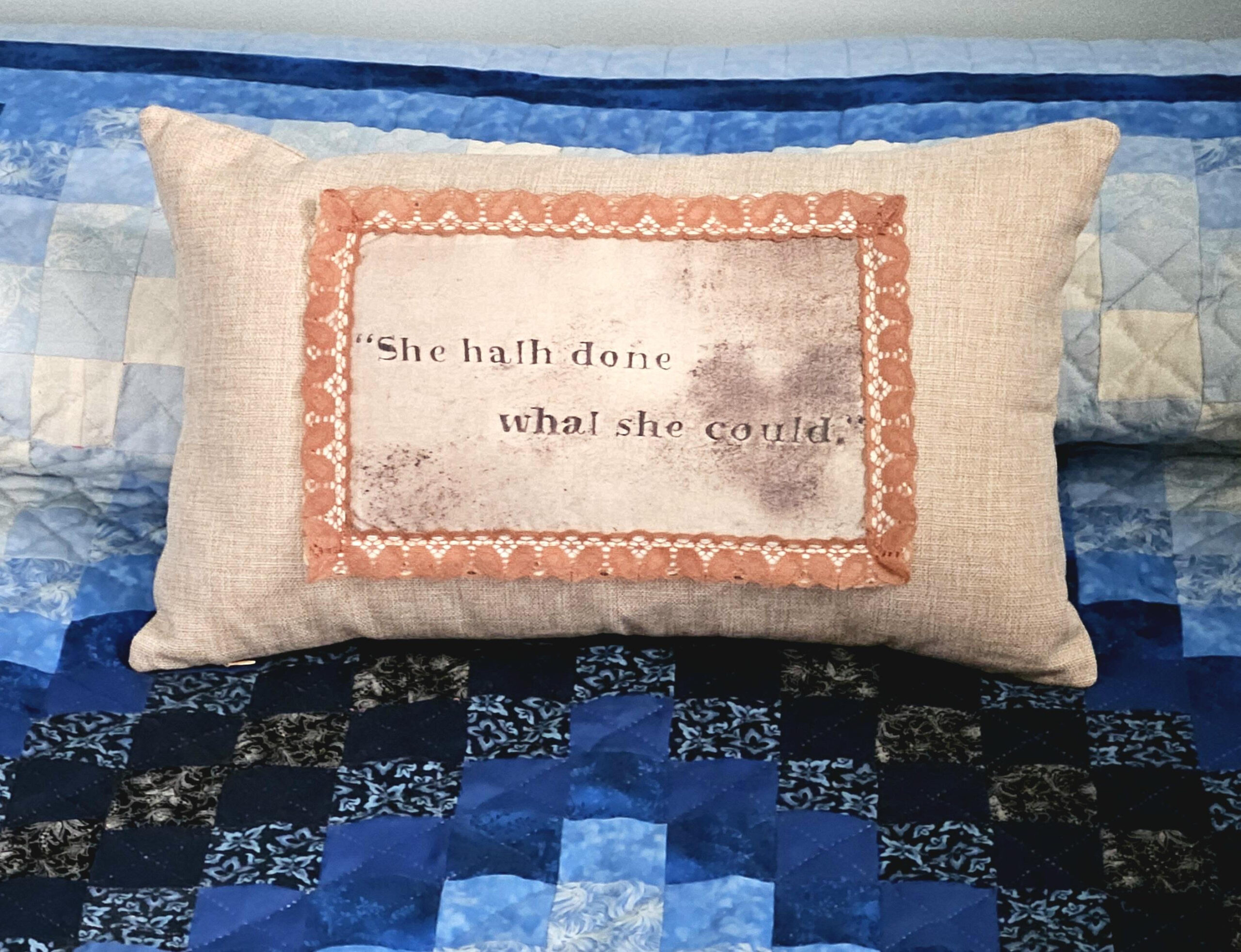
Walking in a Marietta cemetery one cold sunny January afternoon, a headstone caught my eye. The badly worn marble marks the grave of one Margaret M. Barr, 62 years old when she died in December of 1868. Carved into the stone is the tribute, “She hath done what she could.” It stopped me in my tracks.
This woman was not lauded for any particular accomplishment. Rather, her loved ones implied that whatever she did in this life was enough, and by that very fact, it was good.
The sentence stayed with me. I began saying it to myself, first at the end of a long, demanding day, then during the day, when detecting the outer limits of my energy, my willpower, my ability, or even my interest in completing something. Referring to myself in the third person, I now say out loud, “she hath done what she could,” which gives me permission to stop and say, ‘it’s enough,’ good or otherwise. It reminds me to cut myself some slack.
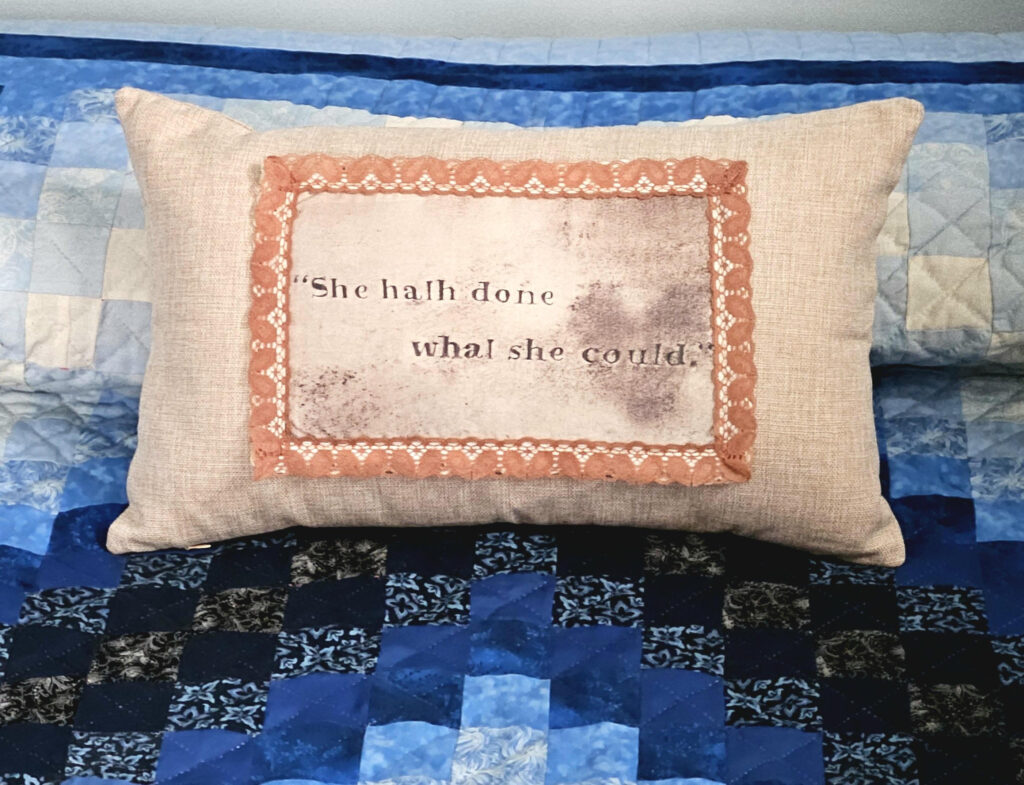
This pillow photographically captures Margaret’s tribute just as it was carved over 150 years ago. Place it on your bed, and as you move it aside as you prepare to sleep, let the sentence soothe any lingering stress over what was left undone, or not yet begun that day. Let it remind you that tomorrow is a fresh start but for now, rest, sleep, and dream with a clear mind and heart.
Backstory
Robyn is the photographer who helped transform my photo of Margaret’s headstone into a printable image for these pillows. In her studio one day, she looked up the sentence, ‘she hath done what she could.’ We learned that the sentence is spoken by Jesus, according to the Gospel of Mark, chapter 14, and that this was a common funereal tribute to mid-19 th century women.
Why? Because as the story goes, an unnamed woman approached Jesus before what’s now called the Last Supper, in other words a Passover Seder. She broke an alabaster box containing precious spikenard oil and poured it on Jesus’ head.
The disciples criticized her for wasting the oil. She could have sold it for “300 pence” says the King James bible, and given that money to the poor. Jesus defends her, saying, “Let her alone. She hath wrought a good work on me…She hath done what she could. She is come aforehand to anoint my body for the burying.” He finishes with, “Wheresoever this gospel shall be preached, throughout the whole world, this also that she hath done shall be spoken of for a memorial of her.”
This anonymous woman knew Jesus would soon be betrayed. She acted on her inner knowing, giving up her valuable oil to bless him, in the face of harsh criticism. And he gave her second billing. She’s the opening act, and a largely forgotten one today. In the mid-19 th century, “she hath done what she could” would have been understood as praise for women otherwise unrecognized in their lifetime. In our age of celebrity and influencers, where former Facebook CEO Sheryl Sandberg’s book, “Lean in: Women, Work and the Will to Lead” was a best-seller, our anonymous oil-pouring female feels out of step.
But is she? Are we? Would I have the courage to break that alabaster box holding precious oil without a thought of its market value? Would I be proud of Marietta’s Margaret Mann if she were my great, great-grandmother? What if my future headstone said, “She hath done what she could”? Wouldn’t that be enough?